Fiber-to-chip coupler · AI data centers
Light, delivered to the chip.
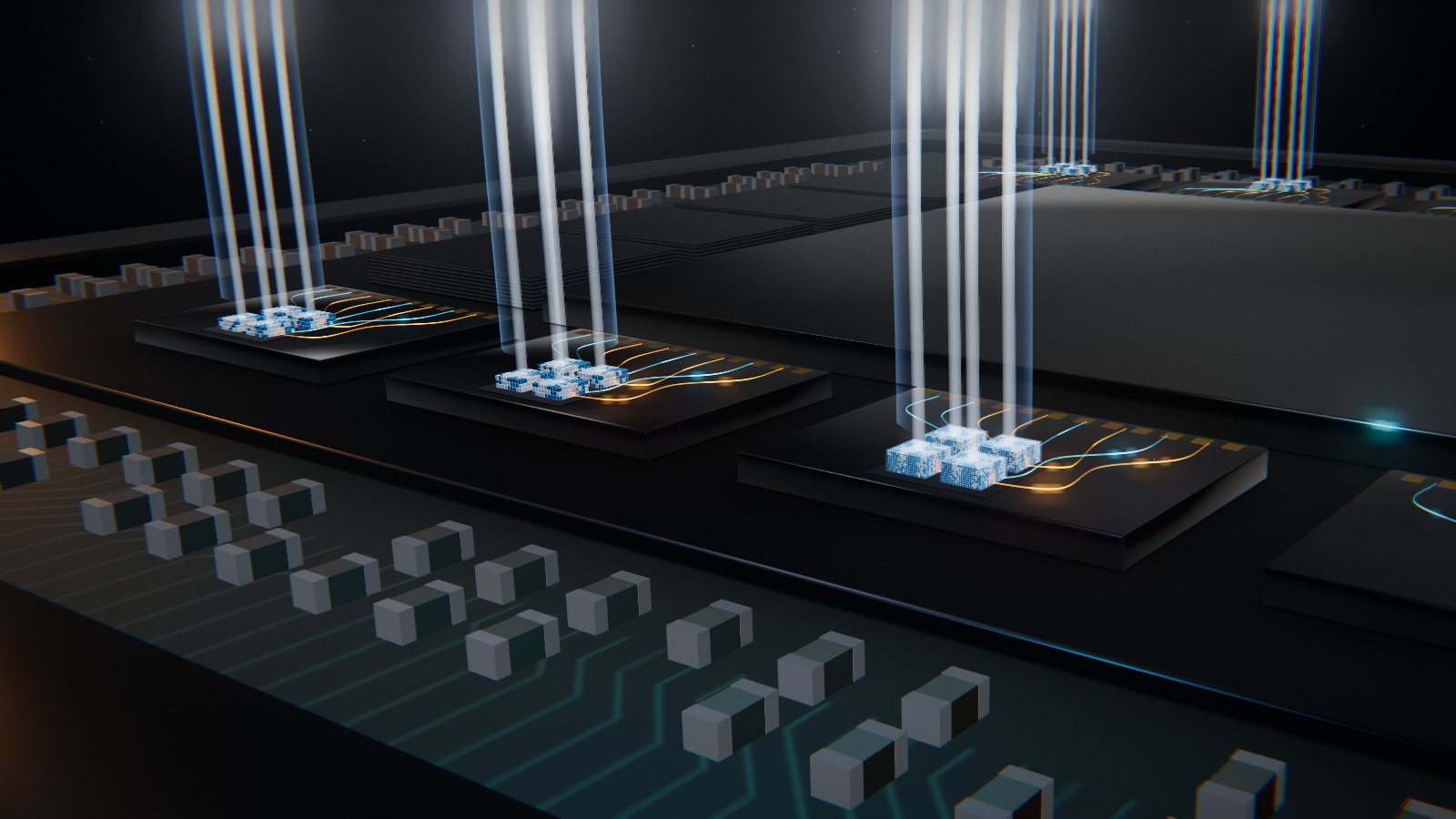
One grown element per fiber core takes light from a multicore fiber straight into a co-packaged chip. It replaces the last hand-assembled part in the optical link.
Today: a fan-out to four fibers, a fiber array glued at the chip edge, then spot-size converters and polarization splitters on the chip. Light is lost at every step.
The junction
Co-packaged optics moved the transceiver onto the package. The coupler stayed manual.
A chain of parts, assembled by hand
- Fan-out from one multicore fiber to four single fibers
- Fiber array, actively aligned and glued at the chip edge
- Spot-size converters and polarization splitters on the chip
- 11 to 48% of the light reaches the chip
One element, grown in place
- The multicore fiber lands directly on the chip
- One grown element under each core
- Turns the light into the chip and sorts polarization in one step
- 69% of the light reaches the chip (modeled)
Why it matters
The light that arrives sets the laser.
Every photon lost at the coupler has to be made up at the source. Deliver 11% and the laser must emit nine times the signal. Deliver 48% and it emits 2.1 times. Deliver 69% and it emits 1.45 times.
Lasers that run cooler last longer, and fewer are needed. Packaging is also where the money goes: by industry estimates it is up to 80% of an optical module's cost.
| Approach | Light delivered |
|---|---|
| Today's assemblies | 11% to 48% |
| Claustrum coupler (modeled) | 69% |
At scale
What one coupler is worth across a site.
See it at the scale of your site
Loss, power and cost figures are modeled or third-party estimates, not measurements on a shipped part. Sources and calculations are available on request.
The product
Fiber-to-chip coupler
We are developing the coupler with design partners. If you build optical engines, run a photonics process, or make multicore fiber, we would like to design against your chip.
- Works with
- Four-core multicore fiber (SDM4)
- Function
- Turns light into the chip, sorts polarization
- Replaces
- Fan-out, fiber array, converters, splitters
- Light delivered
- 69% (modeled)
- Made by
- Growth on the wafer, in parallel
- Availability
- Design partner program
Who it is for
Optical-engine makers and foundries
A coupler that arrives as part of the wafer, with no fiber array to align and attach at the end of the line.
Multicore fiber makers
A direct landing for four-core fiber, without fanning it back out to single fibers at the chip.
Data center operators
Lower laser power per link, across every link in the building.
Design against your chip.
Tell us about your optical engine and the fiber you plan to use. We will tell you plainly what we can and cannot do yet.